

Service accounts and automation are the lifeblood for effectively working cloud information facilities and operating enterprise processes – and GCP is one vendor making an modern transfer on this space. It is available in an extraordinary, not-attention-seeking electronic mail about some coverage change to its clients. A brand new setting permits customers to configure how GCP reacts when a personal service account key leaks. Is that this the beginning of a bigger shift in how distributors strategy cloud safety? Understanding the importance first requires some background.
Service Accounts Fundamentals
Service accounts are a necessity for automation in each software structure and information middle. After proving their identification, they permit purposes and scripts to entry (cloud) sources. GCP provides varied authentication choices for service accounts, similar to identities connected to sources (e.g., VMs), Workflow Id Federation, or service account keys. Google actively warns in opposition to utilizing the latter (Determine 1), although they’re a necessity for some use instances, particularly for entry exterior of GCP and/or the corporate’s perimeter. So, GCP has such a characteristic (2).

Determine 1: Creating and managing entry keys for service accounts within the Google Cloud Platform
Service account keys are as safe (or barely safer than) person/password combos. Nonetheless, over the latest years, all of us realized that securing person accounts with just one issue is insufficient. Attackers too typically succeed by tricking customers into revealing their secrets and techniques – utilizing phishing assaults, for instance. With just one think about place, attackers take over the person accounts and are in a company’s community. Thus, multi-factor authentication (MFA) – utilizing Authenticator apps or (extra legacy) textual content messages turned cutting-edge. MFA prevents hackers from accessing accounts who stole the password with the second issue.
Service Account Safety Dangers
The problem for service accounts is that MFA doesn’t work, and network-level safety (IP filtering, VPN tunneling, and so forth.) just isn’t consequently utilized, primarily resulting from complexity and prices. Thus, service account key leaks typically allow hackers to entry firm sources. Whereas phishing is uncommon within the context of service accounts, leakages are continuously the results of builders posting them (unintentionally) on-line, typically together with code fragments that unveil the person to whom they apply. Dialogue boards on the web are one taste; extra virulent is importing code and information with credentials to the general public GitHub by mistake (Determine 2, 1). Then, hackers can merely scan the GitHub repositories and harvest cloud credentials (Determine 2, 2).
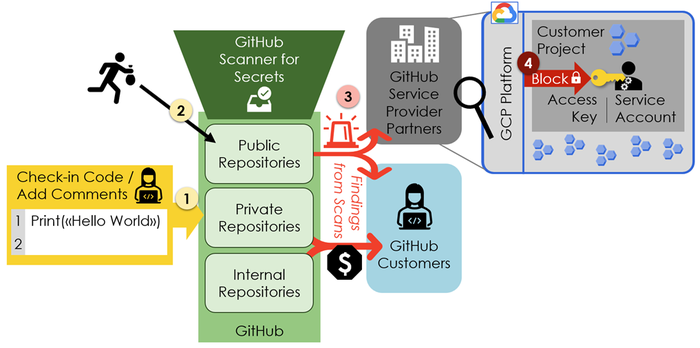
Determine 2: GitHub, Credentials, GCP – The Huge Image
Unintentional credential uploads to GitHub are clearly so prevalent that GitHub applied a characteristic for scanning for secrets and techniques. It checks uploaded information and different info. Service suppliers (e.g., cloud or SaaS suppliers) can accomplice with GitHub to implement scans for his or her particular credentials’ codecs. When GitHub finds such credentials, it informs the shoppers who uploaded the information and the service supplier through which context the credentials are used (Determine 2, 3). In additional element:
-
GitHub informs the shopper and the service supplier of credentials in public repositories. This service is free for patrons.
-
GitHub informs clients (and never the service suppliers) if credentials are uploaded to non-public or inner repositories if clients pay for a GitHub Superior License.
The most important cloud suppliers similar to AWS, Azure, Google Cloud, and Alibaba Cloud collaborate with GitHub on safety. Past the massive public clouds, GitHub additionally scans for credentials associated, e.g., to OpenAI, Slack, Tableau, or Dynatrace. The record of taking part small and massive tech corporations is way from complete. Nonetheless, the most important cloud suppliers collaborate, which is an enormous step in defending cloud information facilities.
Dealing with Leaked Entry Keys: Then and Now
The traditional method to deal with credential leaks is for GitHub to tell the shopper (and repair supplier) in regards to the leak. Then, the shopper’s operations and engineering groups repair it. The engineering group should get the data, react to it, and never deprioritize or postpone the duty. The groups would possibly even be reluctant to rotate the entry key because it requires two simultaneous modifications:
-
The brand new entry key have to be in place within the cloud.
-
The invoking purposes should swap to the brand new key. Different inner or exterior groups may need to vary their code or configurations.
Each actions should happen in sync; in any other case, purposes may be impacted. Thus, it’d take some time for engineers to be snug rotating the important thing. Within the meantime, hackers can break into the service account (Determine 3, higher half).
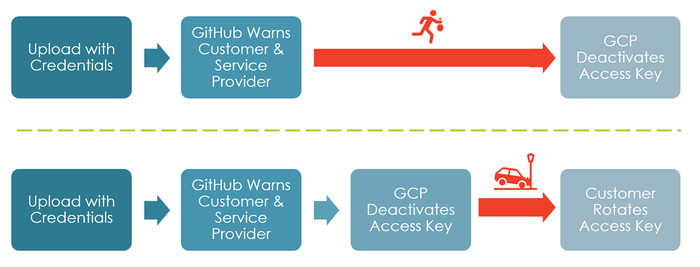
Determine 3: Fixing credential leakages – traditional (prime) and new strategy (down)
Now, Google has modified the sport with its latest coverage change. If an entry key seems in a public GitHub repository, GCP deactivates the important thing, irrespective of whether or not purposes crash. Google’s announcement marks a shift within the threat and precedence tango. Gone are the times when patching vulnerabilities may take days or even weeks. Welcome to the fast-paced cloud period. Zero-second assaults after credential leakages demand zero-second fixing. Stopping an exterior assault turns into extra necessary than avoiding crashing buyer purposes – that’s a minimum of Google’s opinion. Whereas Google doesn’t drive its clients to make use of the characteristic, selecting a much less strict setting might be the much less favorable selection for many clients.
The revolution in entry key safety essentially modifications the dynamics between cloud suppliers and their clients in two areas:
-
A cloud supplier proactively modifications buyer settings slightly than simply reporting points, thereby accepting that buyer purposes break. It’s a deviation from the shared duty mannequin we all know from the early days of cloud computing, the place a cloud supplier’s duty ends with offering safe constructing blocks, and the remainder is as much as the shopper.
-
No “seatbelt tax,” as identified by different cloud suppliers. Think about shopping for a automotive and getting a name one yr later: “Driving with out a seatbelt is harmful. Need to improve your automotive model with a seatbelt to outlive automotive accidents? It’s 10,000 EUR plus 5 EUR each time you shut your seatbelt!” With such pricing fashions, most automotive drivers would nonetheless not put on seatbelts right this moment. So, kudos to GCP for not attempting to monetize each new safety menace individually.
What I’m actually interested by is whether or not Google’s transfer will assist reshape cloud safety in an impactful approach. Will Google roll out extra of those proactive safety features? How will different cloud distributors reply? Completely different cloud suppliers would possibly rely extra on safety revenues and act in a different way. So, will the proactiveness of cloud distributors turn into the brand new norm, and can we see an finish to seatbelt taxation? Keep tuned!


