

Most PC players know {that a} laptop computer with a discrete GPU from AMD or (almost definitely) Nvidia is a must have for enjoying trendy PC video games on a transportable machine. But, regardless of that, many individuals discover themselves compelled to just accept an built-in graphics processor (IGP) bundled as a part of an Intel, AMD, or Qualcomm Snapdragon processor. GPUs are costly, are likely to run scorching, and require loads of juice, and these issues could make a laptop computer with a GPU undesirable or unaffordable.
So, if you wish to sport on a laptop computer with built-in graphics, which ought to kind you purchase? To seek out out we examined 5 laptops toe-to-toe in eight benchmarks, six of that are in style real-world video games you’ve heard of and may even play eagerly. The outcomes present why you want to select an IGP fastidiously: it might probably imply the distinction between taking part in your favourite PC sport at a clean, fluid 60 FPS, or struggling by way of an unplayable sideshow.
The laptops we examined, and the way we examined them
We examined 5 laptops, all with totally different built-in graphics options. They embrace:
- Microsoft Floor Laptop computer 13 Seventh-gen with Qualcomm Snapdragon X Elite and Qualcomm Adreno built-in graphics
- Dell Inspiron 14 Plus with Intel Core Sequence 7 155H and Intel Arc built-in graphics (with eight Intel Xe cores)
- Acer Swift Edge 16 with AMD Ryzen 7 8840U and AMD Radeon 780M built-in graphics (RDNA 3, 12 compute items)
- Asus Zenbook S 16 with AMD Ryzen AI 9 365 and AMD Radeon 880M built-in graphics (RDNA 3.5, 12 compute items)
- Asus ProArt P16 with AMD Ryzen AI 9 370HX and AMD Radeon 890M built-in graphics (RDNA 3.5, 16 compute items)
We chosen these laptops as a result of we really feel they’re in style, mainstream fashions consultant of frequent configurations. With that stated, it’s essential to notice efficiency can range between laptops with the identical IGP, relying on the particulars of how a laptop computer is configured by its producer. Our laptop computer evaluations can present perception into how laptops aside from these examined right here carry out.
All checks we carried out on exterior energy with the default efficiency profile and fan mode.
The Asus ProArt P16 additionally has an Nvidia discrete GPU. It was disabled for our checks.
Lastly, remember that only a few video games accessible on Home windows have an Arm model accessible, together with the video games we used for testing. Due to this, the Qualcomm chip (which makes use of the Arm instruction set) ran video games developed for x86 processors by way of Microsoft’s PRISM emulation. The one exception to that is 3DMark Night time Raid, which does supply an Arm-native model. PC sport builders at present make little effort to develop video games for Home windows on Arm, and that is unlikely to alter till Steam, GOG, and The Epic Video games Retailer add help for Arm-native PC video games.
The video games
We examined built-in laptops with two artificial benchmarks from in style benchmarking instrument 3DMark alongside a roster of in style PC video games. The video games have been chosen to characterize a wide range of genres that stress a laptop computer in several methods. We additionally wished to check video games you’re more likely to play, so we caught to video games which are at present in style on Steam.
3DMark Time Spy and Night time Raid
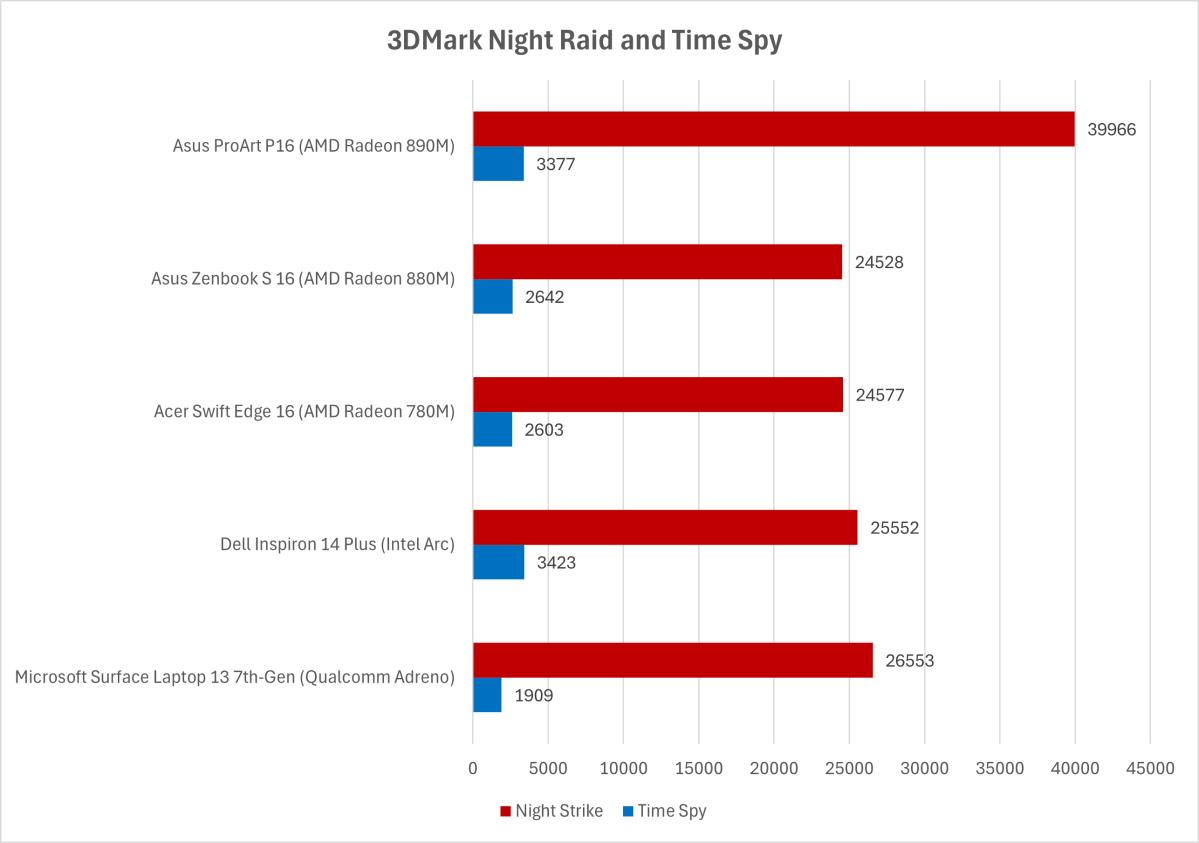
3DMark Night time Raid and Time Spy are great artificial benchmarks from UL Options. Night time Raid is a much less demanding benchmark, however notable as a result of it has an Arm native model accessible on Home windows. Time Spy is a extra demanding benchmark, although a number of occasions faraway from essentially the most demanding benchmarks accessible in 3DMark, and doesn’t have an Arm native model.
IDG / Matthew Smith
IDG / Matthew Smith
IDG / Matthew Smith
These outcomes instantly counsel we’ve received an in depth competitors on our fingers. The 3DMark Time Spy outcomes are a close to factor, and the Night time Raid outcomes are much more aggressive. On the entire, although, it’s a struggle between Intel Arc and AMD Radeon 890M for the highest slot. Whereas Arc was quickest in Time Spy, the Radeon 890M took a considerable win in Night time Raid.
I additionally wish to name out the Qualcomm Adreno’s Night time Raid rating of 26,553, which is the second-best end result from this pack. That signifies Adreno can ship aggressive efficiency when operating an Arm native app. Sadly, that is the one Arm native check we ran. Adreno after all performs extra poorly below emulation, as proven by the Adreno’s rating of simply 1,909 in Time Spy.
Sid Meier’s Civilization VI
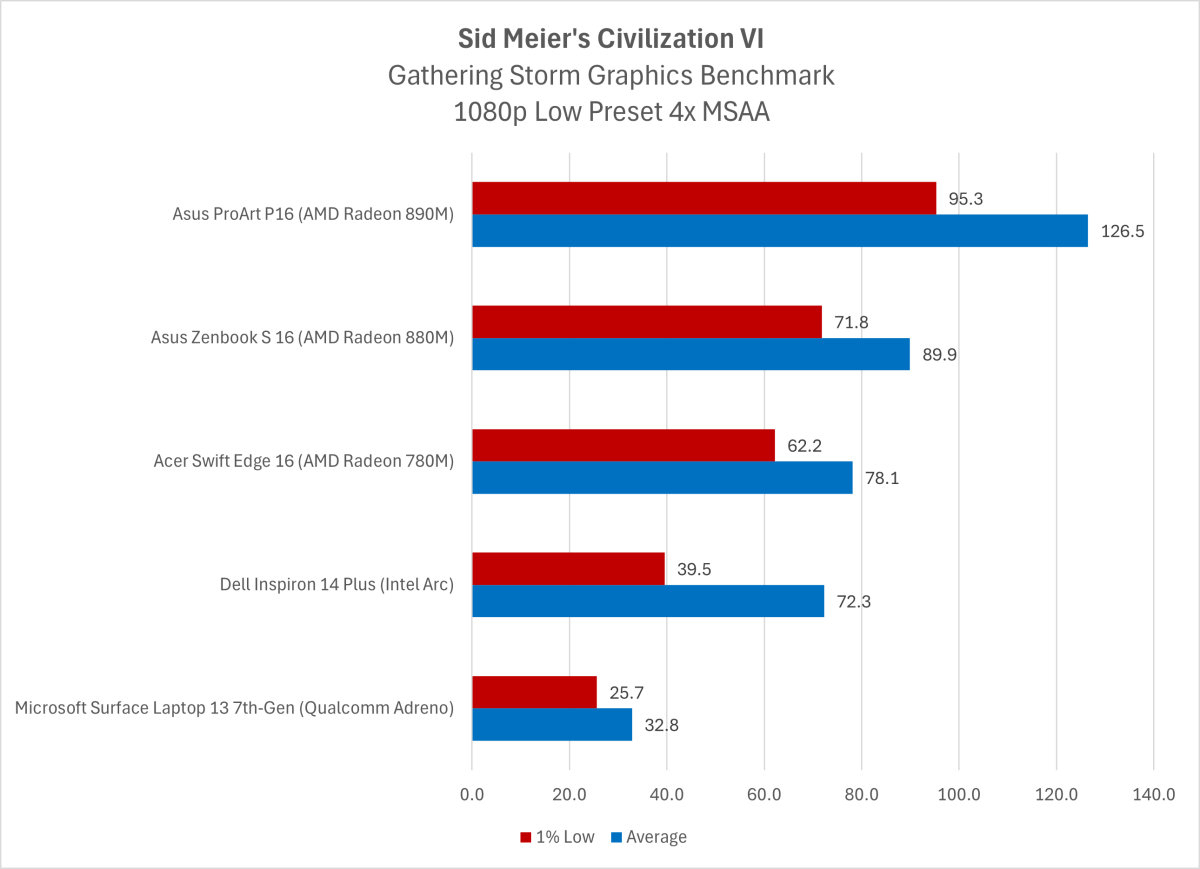
Civilization VI is an older sport, nevertheless it stays extraordinarily in style. It’s additionally match for built-in graphics, as the sport’s visuals don’t overtax built-in GPUs and don’t demand loads of video reminiscence.
IDG / Matthew Smith
IDG / Matthew Smith
IDG / Matthew Smith
Due to that, each built-in GPU aside from Qualcomm’s Adreno was capable of exceed 60 frames per second, and most have been capable of ship that stage of efficiency constantly.
AMD’s Radeon built-in graphics dash away from Intel Arc, nevertheless. The Radeon 780M’s lead over Intel Arc is small, however the newer Radeon 880M springs forward to a end result simply shy of 90 frames per second. AMD’s top-of-the-line Radeon 890M is faster nonetheless and manages to exceed a mean of 120 frames per second.
These enhancements are significant. They might permit smoother gameplay on high-refresh shows or, alternatively, present headroom to show up a couple of element settings.
DOTA 2
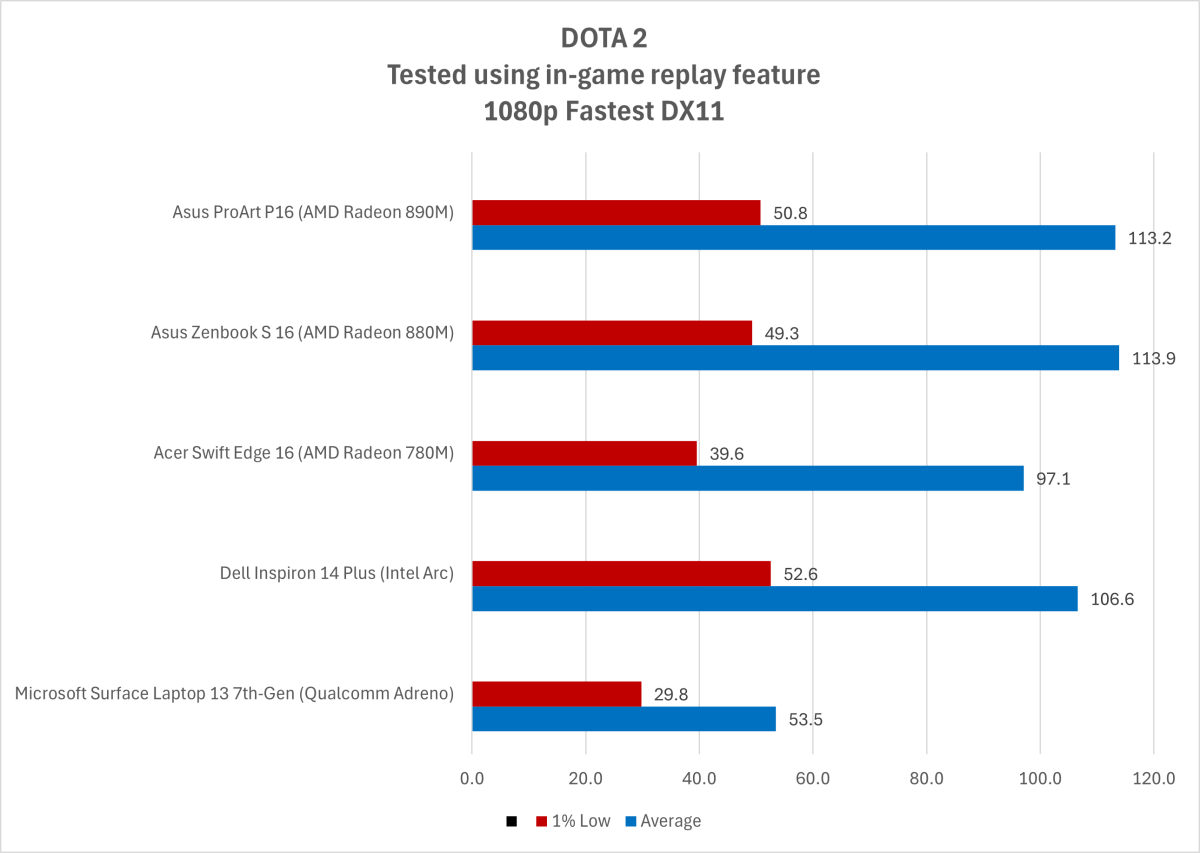
Valve’s DOTA 2 undoubtedly suits within the ranks of “largest video games nobody appears to speak about any extra,” however make no mistake: it’s nonetheless huge, with a whole lot of hundreds of simultaneous gamers daily. It’s additionally gentle on {hardware}, which maybe contributes to its ongoing reputation.
IDG / Matthew Smith
IDG / Matthew Smith
IDG / Matthew Smith
AMD Radeon and Intel Arc ship even efficiency right here. Whereas the Radeon 880M and 890M rating a win over Intel Arc, it’s not a significant victory. And that win is considerably counterbalanced by AMD Radeon 780M falling behind Arc. Importantly, all of those choices show able to taking part in the sport effectively in extra of 60 frames per second.
Qualcomm Adreno sadly falls behind as soon as once more. DOTA 2 is playable, which is spectacular given the sport is operating by way of emulation, nevertheless it’s roughly half as fast because the AMD Radeon and Intel Arc choices.
Closing Fantasy XIV
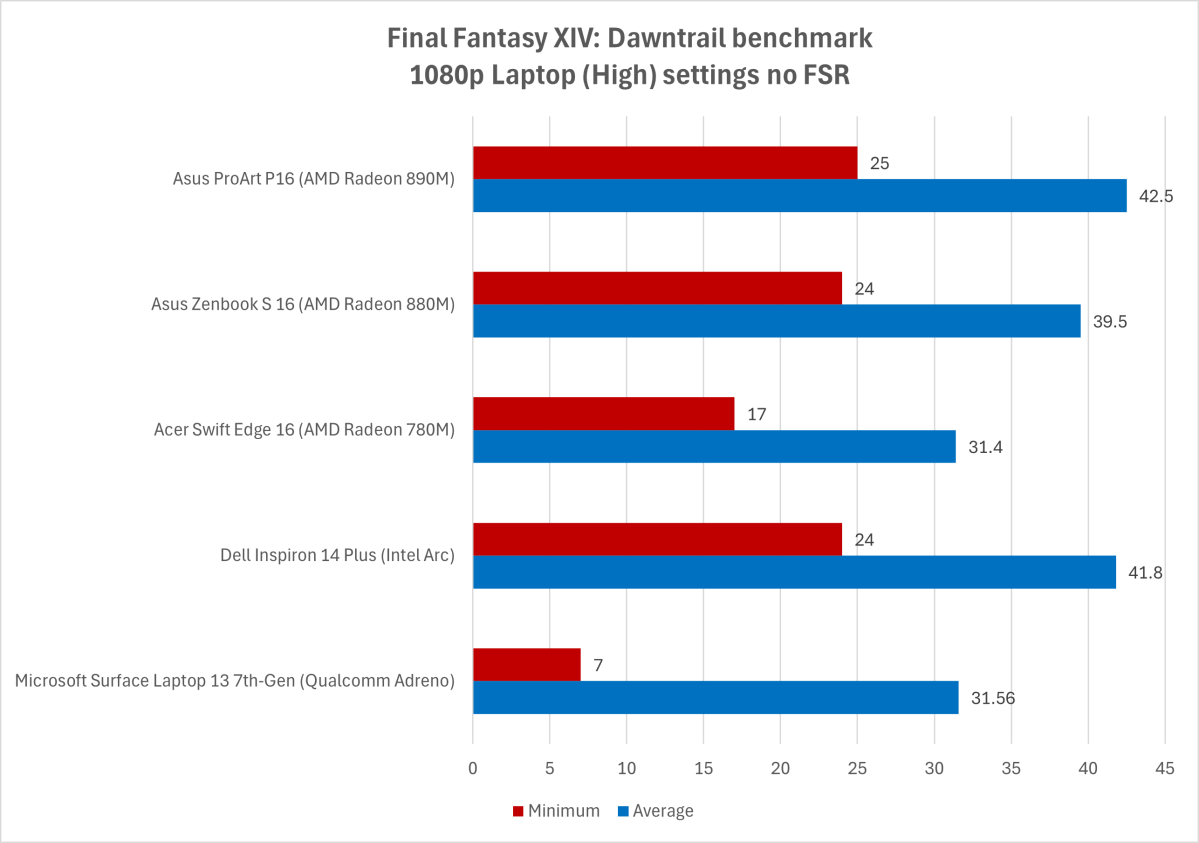
Sq. Enix’s in style MMORPG Closing Fantasy XIV obtained a graphics replace in a patch associated to the brand new enlargement, Dawntrail. The replace doesn’t drastically enhance its {hardware} necessities, nevertheless it’s important sufficient to as soon as once more make Closing Fantasy XIV a problem to run on built-in graphics on the Excessive (Laptop computer) setting.
IDG / Matthew Smith
IDG / Matthew Smith
IDG / Matthew Smith
The sector is surprisingly even right here. The AMD Radeon 890M, 880M, and Intel Arc options all ship playable efficiency, though the minimal framerates dip into the mid-20s. For my part, gamers trying to dive into the harder content material, like raids, would wish to change to the Low element preset for smoother gameplay. AMD’s Radeon 780M falls a bit behind, nevertheless.
Qualcomm Adreno is behind the pack, however that is in some methods end result. Once more, the sport is operating below emulation right here, and regardless of the just about painfully low minimal framerate I might name it “barely playable.” Nonetheless, Adreno is noticeably behind the competitors, and I wouldn’t advocate it for this sport.
Whole Struggle: Warhammer III
Whole Struggle: Warhammer III is a grand technique sport like Civilization VI, nevertheless it’s newer and somewhat demanding on laptop computer {hardware} even with graphics element saved to the Low preset. The sport proves an excessive amount of for some built-in graphics options.

IDG / Matthew Smith
IDG / Matthew Smith
IDG / Matthew Smith
The Qualcomm Adreno and AMD Radeon 780M fail to ship a playable expertise on this sport, as each ship roughly 24 frames per second. I suppose that may be tolerable in a method title like Warhammer III, however the choppiness is pronounced. Intel Arc was solely marginally higher; although it hit 30 frames per second on common, the minimal framerate was a disappointing 19 frames per second.
Nonetheless, the AMD Radeon 880M and 890M options rating wins, as each exceed 30 frames per second on common and ship an ample minimal framerate. It’s not one of the best expertise, to make certain, nevertheless it’ll do.
The Elder Scrolls V: Skyrim Particular Version
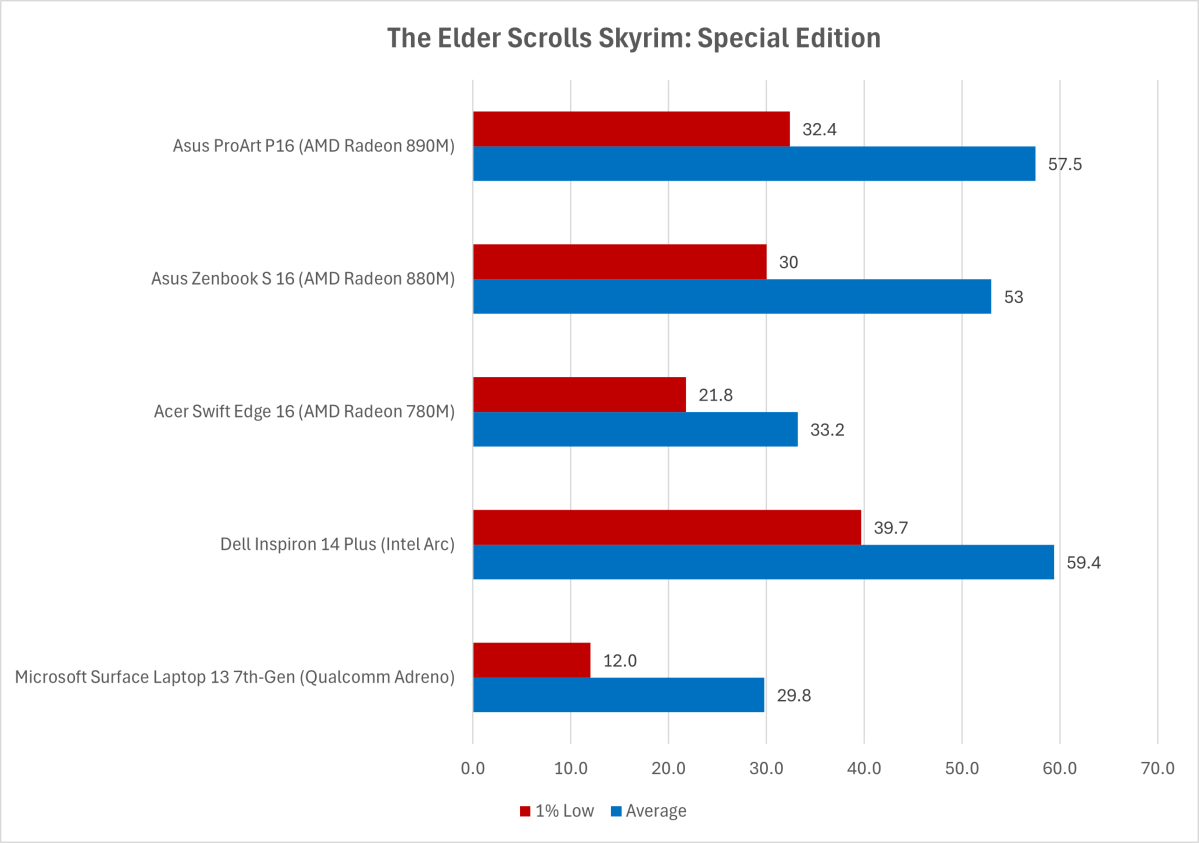
The Elder Scrolls V: Skyrim Particular Version is an fascinating title. Although over 10 years previous, the sport’s stunning visuals can nonetheless problem built-in graphics at 1080p and the sport’s Excessive element preset (Extremely remains to be usually an excessive amount of for IGPs).
IDG / Matthew Smith
IDG / Matthew Smith
IDG / Matthew Smith
This sport is a win for Intel Arc, which manages to barely defeat even the AMD Radeon 890M. It’s additionally a giant loss for Qualcomm Adreno, which suffers from somewhat severe framerate drops. The identical is true of the AMD Radeon 780M, at the very least within the Acer Swift Edge 16, although the problem is much less extreme.
Cyberpunk 2077
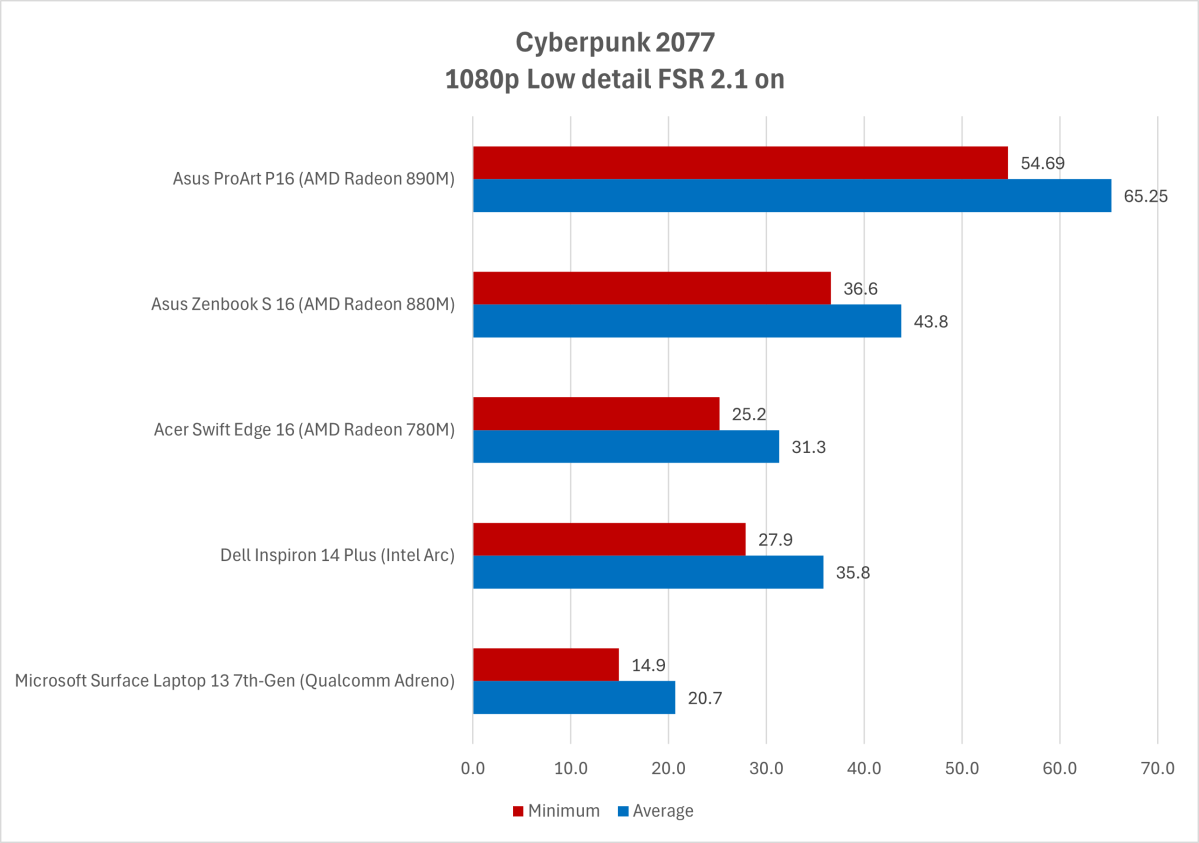
Cyberpunk 2077 is now a number of years previous, nevertheless it stays among the many most demanding video games for contemporary PCs and, regardless of a rocky launch, has loved a resurgence in reputation because of quite a few patches and a profitable enlargement.
IDG / Matthew Smith
IDG / Matthew Smith
IDG / Matthew Smith
This sport does us a favor and delivers a pleasant, readable graph. Qualcomm’s Adreno is clearly on the rear of the pack, as the sport’s common of practically 21 frames per second is nowhere close to playable. Intel Arc and AMD Radeon 780M commerce blows north of 30 frames per second, however Arc takes the win between them. AMD’s Radeon 880M roars in and supplies a significant enchancment over the 780M. Whereas the latter is simply sorta-kinda playable with these settings, the 880M requires no caveats.
AMD’s Radeon 890M, in the meantime, blows away the pack with a superb common in extra of 60 frames per second. That’s not simply playable. It’s actually pleasurable. And it’s the 890M’s most vital efficiency victory amongst all of the benchmarks and video games examined.
Conclusion: AMD and Intel struggle toe-to-toe whereas Qualcomm struggles below emulation
The outcomes current a couple of takeaways anybody purchasing for a laptop computer with built-in graphics ought to know earlier than making a purchase order.
It’s clear that AMD’s Radeon 890M is the victor, because it delivers a major efficiency enhance over the Radeon 880M and one of the best Intel Arc options. In some video games, equivalent to Cyberpunk 2077 and Civilization VI, the efficiency enhance was massive sufficient to ship a lift to fluidity that’s instantly noticeable outdoors of a benchmark. It’s only a disgrace the Radeon 890M is barely discovered within the AMD Ryzen AI 9 370HX and AMD Ryzen AI 9 375HX. I anticipate many laptops with these chips may also have a extra performant discrete GPU, which makes the IGP’s efficiency much less related. With that stated, the Ryzen AI 9 370HX and 375HX might change into in style choices for mini-desktops.
The much less highly effective, however extra frequent, AMD Radeon 880M is one other nice resolution, however Intel Arc is sort of nearly as good. AMD and Intel fought to an actual tie in these checks: every received 4 out of the eight checks we ran. Should you’re in search of a tie-breaker, I might level out that two of Arc’s 4 wins have been in 3DMark artificial checks, which arguably maintain a bit much less weight than real-world sport checks. Buyers also needs to remember that not all variations of Intel Arc are the identical, and a few much less highly effective Intel Core Extremely processors have fewer cores or decrease graphics core clock speeds. Nonetheless, Intel strikes again with availability, at the very least for now: the Radeon 880M is on the market solely on AMD’s Ryzen AI 9 365 in a handful of machines, whereas Intel Arc graphics is on the market in a whole lot of mid-range laptops.
It’s clear Qualcomm’s Adreno is in a troublesome spot, as practically all Home windows video games lack an Arm native model and should run below emulation, which saps efficiency. Adreno has loads of potential, and I’m really a bit shocked by how effectively it does in some video games. Efficiency in Closing Fantasy XIV and Whole Struggle: Warhammer III, for instance, was not that far off the AMD Radeon 780M. However regardless of the causes, the fact is Adreno can’t match AMD Radeon and Intel Arc in real-world situations. That received’t change till PC sport builders resolve to help Home windows on Arm.
On the entire, built-in graphics efficiency is in a great spot in 2024. A succesful IGP, just like the AMD Radeon 880M or Intel Arc with eight Xe cores, can play many trendy video games at 1080p decision, 30 to 60 frames per second, and low to excessive element. Even video games like Cyberpunk are playable (if not fluid) because of upscaling applied sciences like AMD’s FSR and Intel’s XeSS.
There’s nonetheless purpose to be cautious, nevertheless. Some IGPs accessible in trendy laptops, together with older generations of AMD Radeon built-in graphics and Qualcomm’s Adreno, are unlikely to supply expertise. Thankfully, the latest AMD Radeon and Intel Arc IGPs aren’t troublesome to seek out and accessible at inexpensive costs: the Dell Inspiron 14 Plus with Intel Arc is simply $1,000 with 32GB of RAM and a 1TB SSD, and Asus’ Vivobook S delivers the Radeon 880M for $1,200 alongside 24GB of RAM and a 512GB SSD.


