

For those who had any doubts about silicon cooling chips being the wave of the long run, this could assist persuade you: Now there are two corporations working in that house. xMEMS has introduced the XMC-2400, a competitor to the Frore Programs AirJet that was introduced lower than two years in the past.
What xMEMS is asking the xMEMS XMC-2400 µCooling chip isn’t a direct competitor to AirJet’s laptop computer processor coolers, although. For now, it’s aimed toward smartphones and tablets, in addition to SSDs. However, that places it on a collision course with Frore’s AirJet Mini Slim and its future roadmap. In the meantime, xMEMS says it is going to scale up its teeny-tiny cooling chip into one thing bigger and extra sturdy.
Most cooling options for semiconductors are both passive — through heatsinks, which thermally conduct warmth utilizing metals like copper and aluminum — or lively, usually utilizing pressured air through a blower to chill the chip. Lively cooling is usually higher at eradicating warmth, however a fan, blower, or an array of warmth pipes are each costly and take up useful house.
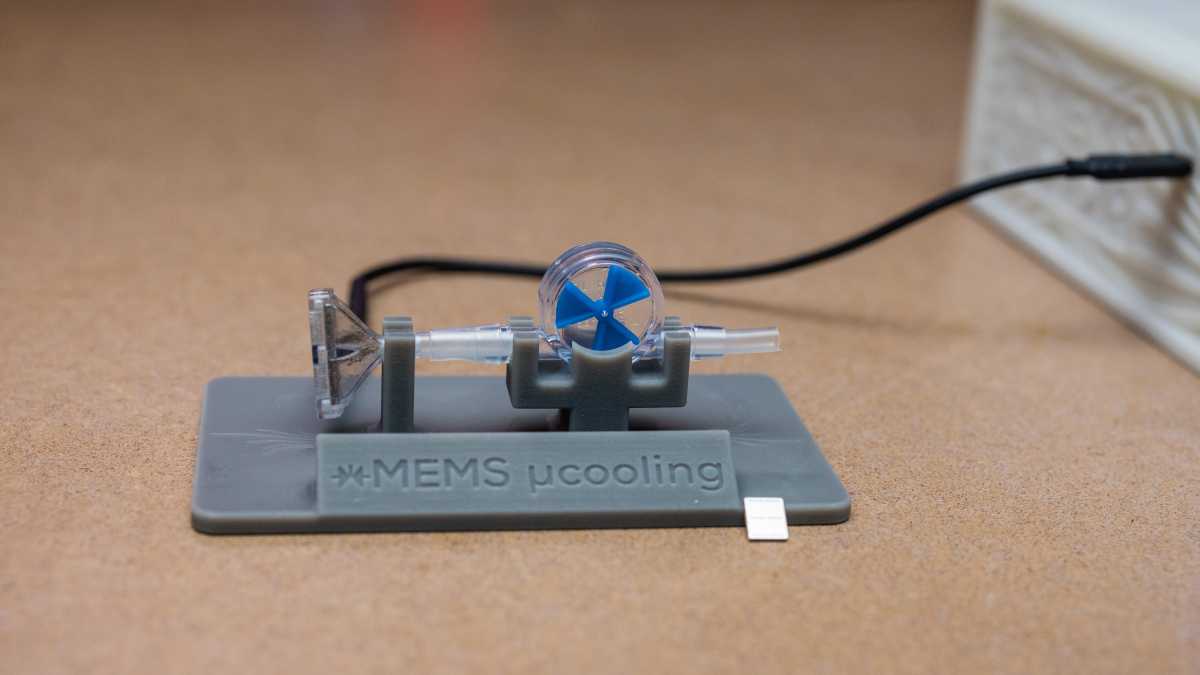
Micro-electromechanical techniques (MEMS) characteristic the perfect of each worlds. They’re small, and could be simply linked to the skin of an current chip. They’re additionally simpler than a passive cooling resolution, as they use a vibrating membrane as a fan of types, sucking in cool air, pushing it throughout the heated floor of the chip package deal, after which pushing the new air out by way of the system and from there exterior of the system.
The argument continues to be the identical: Irrespective of how briskly a chip would possibly run, it will probably’t obtain its prime velocity for extended durations of time. These “turbo” modes usually final for seconds at most, which signifies that the velocity of the chip isn’t the gating issue for chip efficiency, corporations like xMEMS say. Cooling is.
“Every era of processor, impartial of a provider [like] ARM, Intel, Nvidia, et cetera, improves the efficiency versus energy equation,” mentioned Mike Housholder, the vice chairman of selling and enterprise growth at xMEMS “But, at a system degree, we’re by no means capable of obtain the utmost efficiency specs of the silicon for prolonged durations of time. That is at all times gated by system thermal dissipation. So, efficiency is not gated by the capabilities of the silicon.
Willis Lai
Willis Lai
Willis Lai
“To sum it up, I see the thermal administration problem growing, not reducing,” Housholder mentioned.
The introduction of the Frore Airjet was really one of the crucial thrilling bulletins of 2022. Now xMEMS has its personal take.
How is the XMC-2400 completely different than the Frore AirJet?
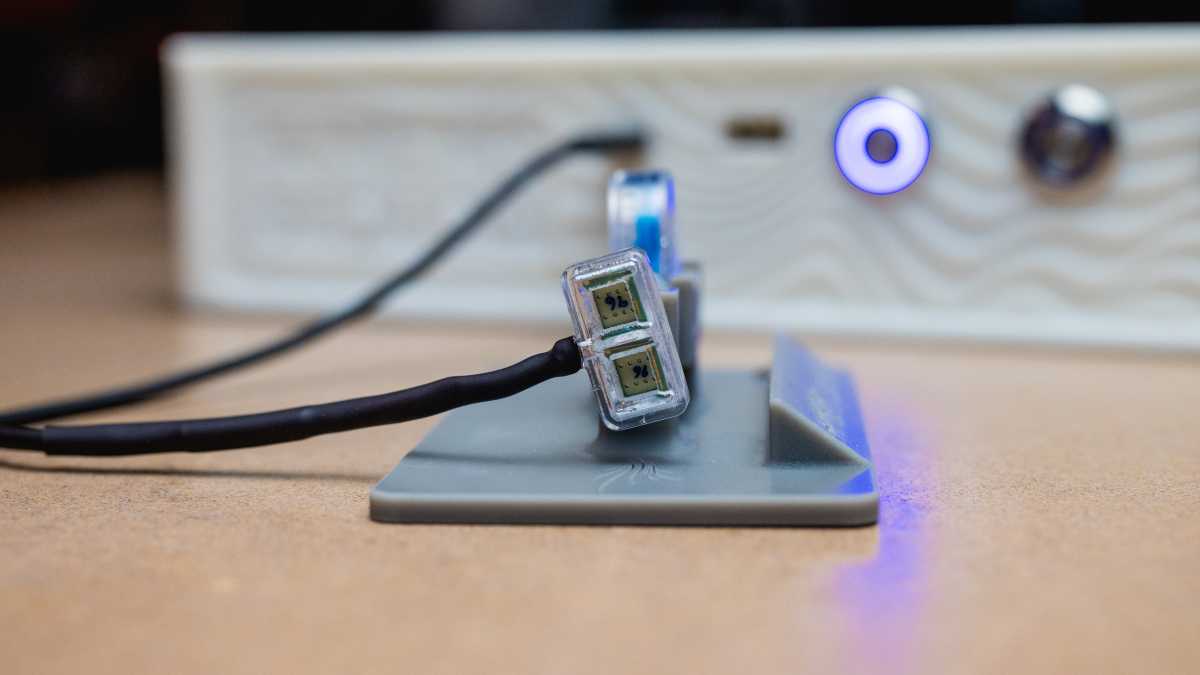
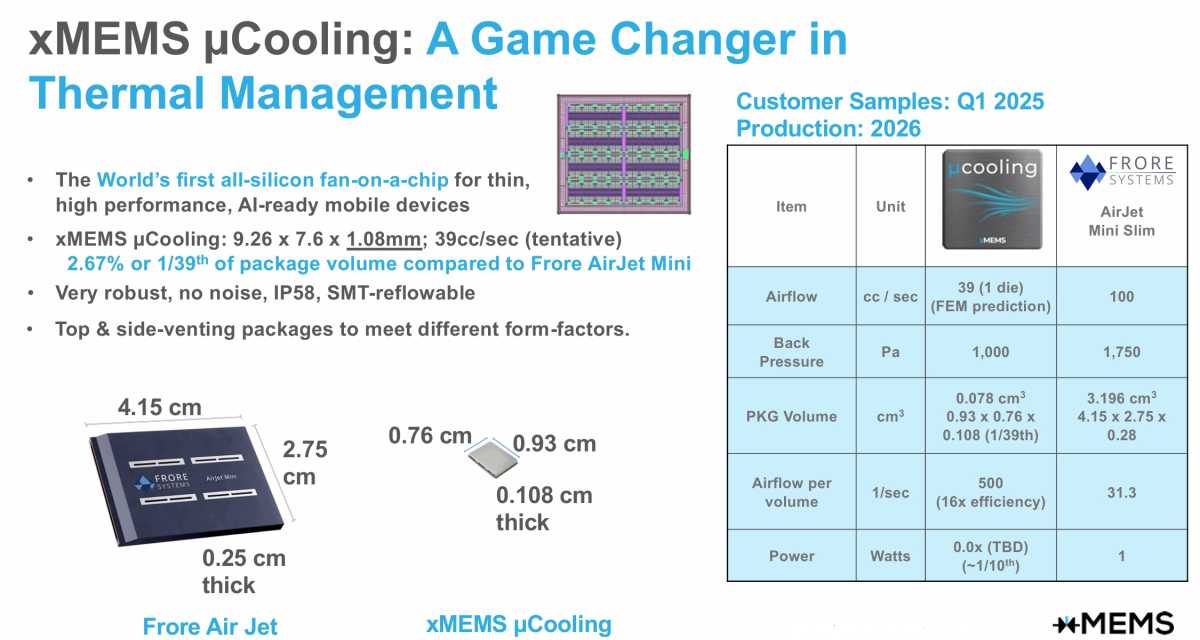
The distinction in strategy is clear simply from the images: The smallest system Frore at present makes is the AirJet Mini Slim, with a 27.5mm x 41.5mm x 2.5mm footprint. Comparatively, the XMC-2400 is tiny: Simply 9.26mm x 7.60mm x 1.08mm.
Why? As a result of xMEMS has been manufacturing MEMS gadgets for a while — however not for cooling. As a substitute, the XMC-2400 comes from the corporate’s legacy of constructing MEMS gadgets as audio system, inside tiny earbuds. A transition away from utilizing MEMS membranes to provide sound to people who might cool a chip was a pure transition, in keeping with Housholder.
Willis Lai
Willis Lai
Willis Lai
xMEMS tech is featured in merchandise just like the Inventive Aurvana Ace 2, in an advance that SoundGuys.com heralded because the audio model of the transition from laborious drives to SSDs. Final November, xMEMS introduced an ultrasonic transducer — usually pitched at above human listening to, however the firm’s expertise allowed it to generate audible sound. “So actually, it’s the identical piezo MEMS platform, however repurposed so as a substitute of producing audible sound for music enjoying, it’s now producing airflow,” Housholder mentioned.
Piezoelectronics can generate voltages when strain is utilized, or vice versa. On this case, the membrane is bodily transferring. “We’ve form of had at the back of our thoughts, for the reason that founding of the corporate, that when we might get to the sound from ultrasound expertise {that a} cooling product could possibly be an offshoot of that; that’s what we’re asserting” Housholder mentioned.
“By enjoying with the frequencies of the ultrasound, we are able to tune it to audible sound or we are able to tune it to airflow,” Housholder added.
Like Frore’s AirJet, cool air is sucked in because the membrane vibrates in a single path, and is pushed towards the warmth spreader of the chip itself. That creates a cavity stuffed with comparatively pressurized air, which is then pushed out by way of a launch valve. The vents could be mounted in both the highest or sides of the package deal. Housholder mentioned that the XMC-2400 is bidirectional, in order that you might have one XMC-2400 immediately cooling a chip, whereas one other is positioned elsewhere within the system, close to a vent, to help pulling or pushing air exterior of the system.
xMEMS
xMEMS
xMEMS
xMEMS’ benefit, in keeping with Housholder, is effectivity: The corporate predicts it is going to transfer 39 cubic centimeters of air per second, through a single die, with 1,000Pa of again strain. Every die consists of an array of MEMS valves; on this case, the XMC-2400 features a two-by-four array, for a complete of eight. The corporate claims a common airflow-per-volume effectivity of 500, versus Frore’s 31.3. It’s additionally 1/39 the dimensions of the AirJet Mini Slim, and attracts one-tenth the facility, between 20 to 30 milliwatts. Just like the AirJet, the xMEMS chip generates basically no noise.
The XMC-2400 is a two-chip resolution; it is going to additionally embrace a management ASIC that can management the opening and shutting of the valves. At this level, the MEMS chip itself is operational; the corporate has acquired the primary revision of the management ASIC and will probably be able to go in a few months, Housholder mentioned.
The longer term: Wait, cooling chiplets?!
Householder mentioned that xMEMS intends to ship the XMC-2400 into smartphones — flagship smartphones, although probably gaming telephones as effectively. Since XMC-2400 is in pre-production, the corporate hasn’t but introduced any clients. xMEMS plans to pattern the XMC-2400 to clients within the first quarter of 2025.
SSDs are additionally a goal. “I feel that we are able to deal with that now,” Householder mentioned. “I feel that market might be effectively suited to our chips as they exist at this time.”
Presently, the corporate is fabricating its chips at each TSMC and Bosch, the latter being the highest MEMS fab on the planet, Housholder mentioned. xMEMS has methods to scale its expertise: growing the variety of valve arrays in every chip die, for one. xMEMS additionally confirmed off a demo the place two XMC-2400s have been working in live performance to maneuver a small fan. There’s no purpose why xMEMS or a buyer couldn’t have various the chips working in live performance.
And Householder recommended one other, extra intriguing chance: Considering of the XMC-2400 or a by-product as a cooling chiplet, inside the SOC of a traditional microprocessor. That’s not out of the vary of chance, after all. Intel’s upcoming Lunar Lake chip, consisting of a number of chiplets, is made up of a number of chiplets manufactured by TSMC.
That might imply that the chip vendor must agree, and the SOC package deal would itself should be vented. It’s additionally not clear by how a lot cooling would enhance. “We’re definitely not the skilled there,” Housholder mentioned. “However once more, I feel that the chance exists and we’re anxious to discover it.”
For now, an important implication appears to be for SSDs, which could have not one however two potential active-cooling options along with their present commodity passive heatsinks. However as xMEMS iterates and bodily expands its cooling options, extra parts inside a laptop computer, together with the CPU, could have extra choices to select from, too. The very best information of all? It appears like cooling chips aren’t only a enjoyable idea. They’re a respectable market.


