
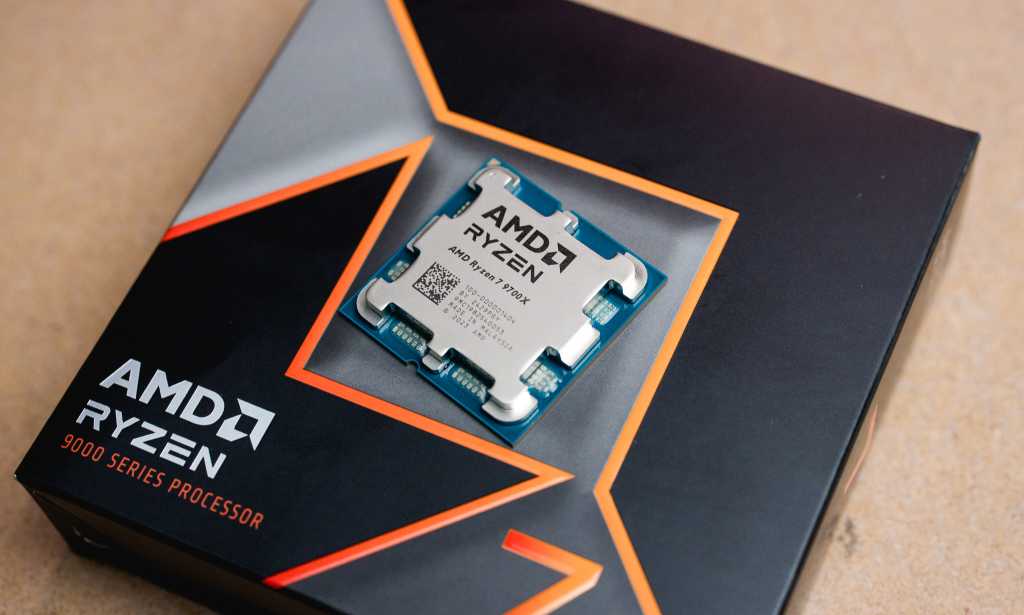
After a quick delay, AMD’s Ryzen 9000 lastly has hit cabinets—however to everybody’s shock, the primary processors include stunning caveats. Regardless of providing lots to love, the $279 Ryzen 5 9600X and $359 Ryzen 7 9700X additionally sport uneven efficiency enhancements.
The explanations for these benchmark outcomes are nuanced, nevertheless. We at PCWorld have even delayed the discharge of our assessment to raised tease out these fine-grain particulars. (You possibly can watch us clarify why on this YouTube video, the place we additionally talk about our preliminary outcomes in-depth.) However for these of you at residence, questioning if Staff Crimson’s newest silicon is value your time and money, listed below are the highest 6 issues you must find out about Ryzen 9000—no less than till the Ryzen 9 processors launch subsequent week on August 15.
Huge enhancements in single-core efficiency
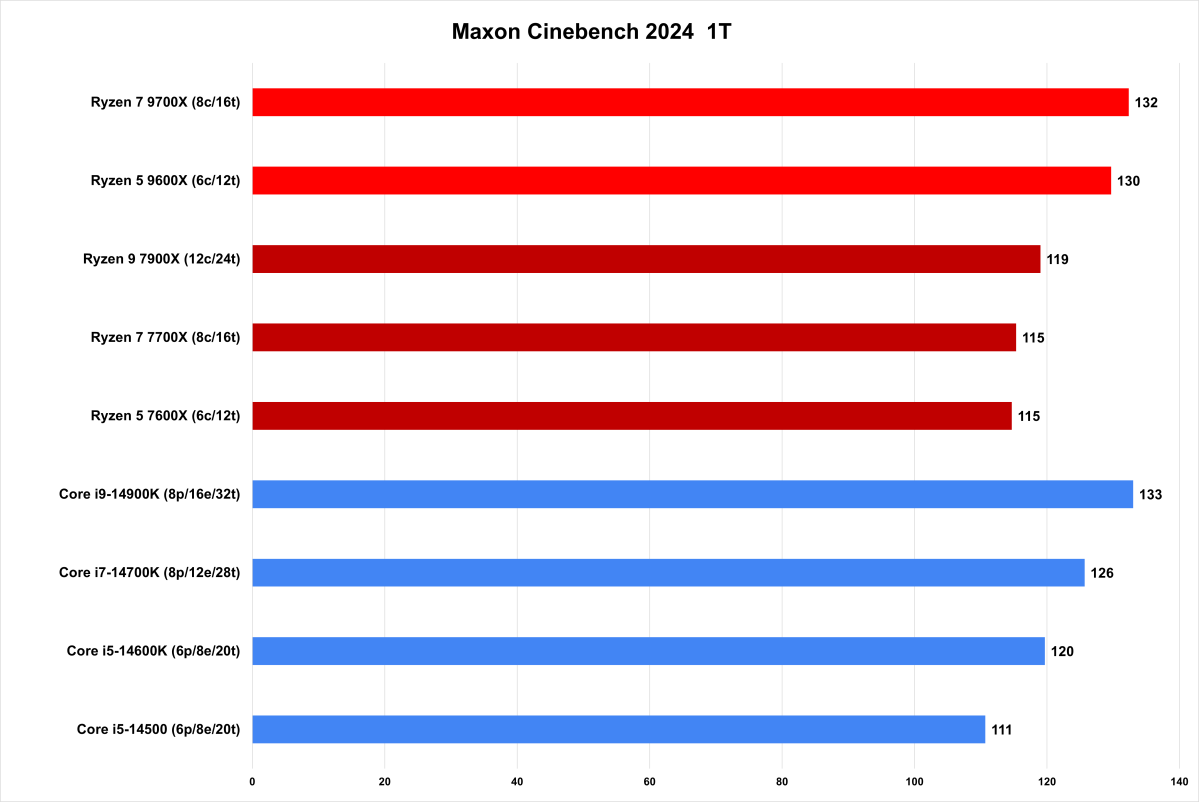
The 6-core, 12-thread Ryzen 5 9600X and 8-core, 16-thread Ryzen 7 9700X could publish comparable numbers in single-core efficiency, however these outcomes put them on the high. In Cinebench R23, one of many rendering benchmarks we use to place CPUs by means of their paces, the 9700X posted an virtually 15 % enhance over the 7700X. Equally, the 9600X outdid the 7600X by 13 %. Each positive aspects are stable upticks.
Adam Patrick Murray / PCWorld
Adam Patrick Murray / PCWorld
Adam Patrick Murray / PCWorld
In the meantime, when pitted towards Intel and its present 14th-generation chips, AMD has the sting. Towards the Core 7 14700K, the 9700X gives a 4.7 % increase in efficiency, and is neck-and-neck with the extra highly effective Core 9 14900K. For its half, the 9600X pulls forward of the Core 5 14600K by somewhat over 8 %, which is a pleasant win for customers conscious of their budgets.
However lackluster positive aspects in multi-core efficiency
Nonetheless, Ryzen 9000 loses some shine if you have a look at its multicore efficiency. In Cinebench R23’s multithreaded take a look at, the 9700X reveals primarily the identical efficiency because the 7700X—the skinny 1.48 % doesn’t exceed a standard testing margin of error (normally between 2 to three %).
The end result is best for the 9600X, with a roughly 7 % enhance in Cinebench in comparison with the 7600X, however that type of uplift is modest in comparison with earlier generational jumps. Usually, 15 to twenty % begins to push the envelope (as seen in single-core efficiency).
For Cinebench and Blender, longer bars point out higher efficiency. For Handbrake (which evaluates pace of take a look at completion), shorter bars are higher.
This story repeats with comparable impact in our different rendering and encoding benchmarks used to guage multicore efficiency. And sadly, with such minimal positive aspects, Ryzen 9000 lags behind Intel’s 14th-gen processors. Choosing a 14700K is a whopping 72 % efficiency enhance in Cinebench over the 9700X, whereas a 14600K is an virtually 60 % increase in comparison with the 9600X. For anybody who wants robust multicore efficiency (whether or not for intensive work like rendering or simply closely threaded video games), Intel might be your higher guess—offered you’re snug with the latest issues round 14th-gen chip efficiency and longevity.
Nonetheless, there’s a twist: Ryzen 9000 multicore benchmark outcomes will be notably affected by motherboard settings—and the best way many reviewers take a look at (together with PCWorld) doesn’t present the silicon’s full vary.
Motherboard settings matter
Two settings in your motherboard UEFI (generally nonetheless colloquially known as the BIOS) can significantly affect how properly Ryzen 9000 performs: Precision Increase Overdrive (PBO) and RAM voltage.
Of the 2, PBO performs a better function in whether or not you’ll see merely meh positive aspects, or if you happen to’ll get nearer to what AMD guarantees. When enabled, it dynamically feeds extra voltage to the processor for clock pace will increase—which give higher efficiency.
Not all motherboards allow PBO by default, so if you happen to purchase a Ryzen 9000 processor and need probably the most out of it, you’ll want to enter UEFI and guarantee it’s on.
Moreover, AMD recommends operating RAM at a voltage of 1.2V, somewhat than 1.25V (a typical setting). Just like PBO, the latter voltage is usually a default on some mobos—like on PCWorld’s personal take a look at {hardware}, a ASRock X670E Taichi.
Altering these settings isn’t tough, however most customers are accustomed to dropping in a chip and shifting on. These crucial tweaks make Ryzen 9000 really feel finickier than earlier generations, which didn’t want such exact dealing with. Nonetheless, based on AMD, a part of the rationale for this end result is because of the decrease TDP of the Ryzen 5 and Ryzen 7 processors. With a tighter ceiling on energy effectivity, the steadiness between efficiency and acceptable working temperature is a finer line to stroll.
Spectacular energy effectivity
From a chip nerd’s perspective, AMD’s capability to coax high-end efficiency out of lower-wattage CPUs is unimaginable. The facility effectivity speaks properly of the engineering—Staff Crimson’s first two Ryzen 9000 CPUs have a default TDP of 65W, or practically half of Intel’s base TDP of 125W for the 14700K and 14600K.
In different phrases, AMD’s processors are posting single-core efficiency pretty much as good as Intel’s utilizing far much less juice. The weaker multicore efficiency is much less to do with an inherent weak spot with the silicon design, and extra to do with how onerous AMD’s prepared to gun the engine for the 9700X and 9600X. We’ve already seen in latest CPU generations that a lot of their gigantic efficiency leaps should do with quantity of electrical energy run by means of the chips. In order hinted by the state of affairs with motherboard PBO settings, that’s the distinction we’re seeing right here.
Stagnant gaming efficiency gen-on-gen

CD Undertaking Crimson
CD Undertaking Crimson
CD Undertaking Crimson
Nonetheless, the body charges you get are the body charges you get—and if you happen to’re a gamer who’s been ready to improve, you’ll wish to really feel that your cash is being invested in a stable bump up.
Reality of the matter is, the 9700X’s gaming efficiency doesn’t transfer the needle a lot previous the 7700X. You’ll see it most in difficult video games, as evidenced by our Cyberpunk 2077 benchmark outcomes the place the 9700X and 7700X mainly carry out the identical. (The small dip will be attributed to that customary margin of error for testing, as talked about above.)
Even in video games extra delicate to CPU enhancements, the positive aspects are modest, topping out at about 7 % in Tom Clancy’s Rainbow Siege Six and F1 2023. For Whole Struggle: Warhammer III, the uplift is even smaller, coming in at simply over 4 %.
Decrease costs than Ryzen 7000

Willis Lai / Foundry
Willis Lai / Foundry
Willis Lai / Foundry
To AMD’s credit score, the corporate is asking for much less cash this time round—so for these watching their budgets like a hawk, a minimal increase in gaming efficiency could not matter as a lot.
The complete lineup sees a discount, with the Ryzen 9 processors dropping by $50 in comparison with final gen, the Ryzen 7 9700X happening by $40, and the Ryzen 5 9600X shaving $20 off the asking worth. (AMD hasn’t confirmed Ryzen 9 costs but however Finest Purchase leaked them.)
- Ryzen 9 9950X – $649
- Ryzen 9 9900X – $499
- Ryzen 7 9700X – $359
- Ryzen 5 9600X – $279
Whereas these costs don’t return to AMD’s extremely reasonably priced MSRPs from earlier generations (like Ryzen 3000), they positively undercut the competitors. At the moment, Intel’s rival chips have road costs of roughly $550 for the 14900K, $380 for the 14700K, and $300 for the 14600K. If you need further multicore efficiency, you’ll should pay for it.


